Most people have a CV (Curriculim Vitae). This is to help a
prospective employer get an idea of your skills, qualifications and
personal qualities, however when working within the creative industry we
can bend the rules a little bit and add into these documents our own
stylistic flair. CV's for creative practitioners can be a much better
way of presenting yourself to potential agents or other clients, as you
can tailor the format of the CV to yourself and let some of your
artistic and commercial style show through. You also don't need to put
ALL of your qualifications into it- only relevant information should be
supplied such as art or design related qualifications and any other
information they may be interested in like work experience and previous
jobs (if any).
However, considering this, these
creative CV's should be sharp and proffesional whether they are eye
catching or not. They should promote your style well and although
presentation is important this doesn't necessarily mean it has to be
really unusual either.
In order to make my own
'creative' CV I am first researching some existing examples and
anaylsing them so I know what works and what really doesn't in regards
to this.
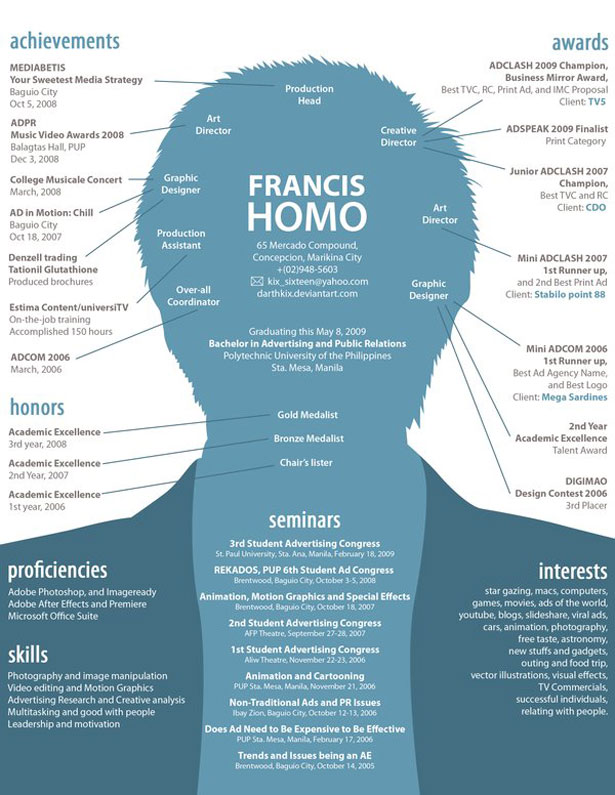
I
did not think this was a great creative CV. If I was an employer and
was handed this, well, first of all I would be confused as to where to
start. There is way too much information and text crammed into too small
a space. The idea was good but the execution could have been a lot
better.
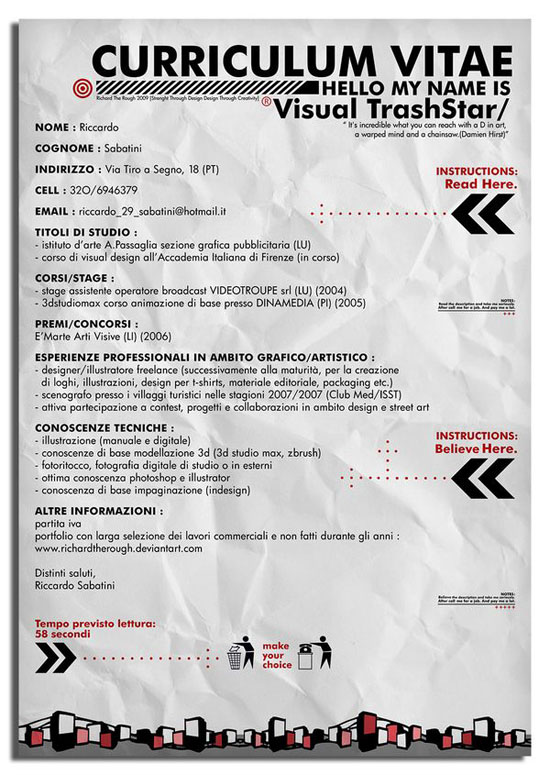
I
liked this CV because the information is laid out in a concise, clear
way in a good type and the colour scheme isn't too loud. I'm not too
keen on the crumpled paper effect but the little arrows and icons add a
nice touch and I especially like the main heading of the page. It's very
graphically designed but I think it works well and I would enjoy
reading a CV like this.
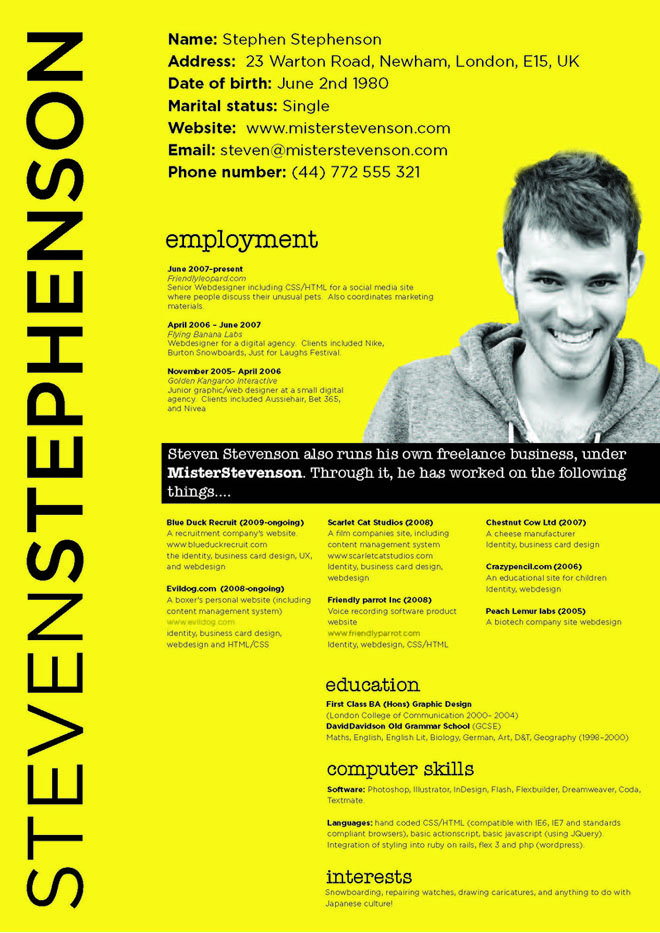
In theory this a good design for a CV.
I
like the general layout of the CV, especially the black dividing box
and the photo he has provided of himself. The information, although not
laid out in a traditional CV style, is well presented in a good typeface
and I like the font he has used for headings.
The only qualm I
have with this CV is the background colour; the bright yellow is a
little too bright for my taste (you want to impress employers, not blind
them!)
Thursday, 13 February 2014
Post Graduate Courses (unfinished)
After I complete this degree course, if I want to I can choose to
enroll in a post graduate course. I've thought about this option a lot
as I would like to further my education, I'm just not sure which course I
would enjoy the most and I like the idea of a few different options,
from Fine Art degrees or curatorial ones.
The entry requirements needed are a relevant Level 6 qualification, which means that if I successfully complete my degree I can progress onto this course. However other entrants without this degree can also enroll on the course if they have suitable professional experience that could possibly be substituted for traditional academic qualifications.
For 2013/14 the course fees are as follows:
£5,540 Full Time UK/EU
£2,995 Full Time UK/EU
Courses in England
Falmouth University
MA Illustration: Authorial Practice
This MA in illustration has a specific focus on narrative (authorial) illustration. The name of the course intrigued me and I was impressed with the quality of work displayed on the professionally presented website.The entry requirements needed are a relevant Level 6 qualification, which means that if I successfully complete my degree I can progress onto this course. However other entrants without this degree can also enroll on the course if they have suitable professional experience that could possibly be substituted for traditional academic qualifications.
For 2013/14 the course fees are as follows:
£5,540 Full Time UK/EU
£2,995 Full Time UK/EU
Intellectual Property Protection
Copyright, as defined on the UK Intellectual Property Office website, can protect:
"
"
You should only copy or use a work protected by copyright with the copyright owner's permission.
- literary works, including novels, instruction manuals, computer programs, song lyrics, newspaper articles and some types of database
- dramatic works, including dance or mime
- musical works
- artistic works, including paintings, engravings, photographs, sculptures, collages, architecture, technical drawings, diagrams, maps and logos
- layouts or typographical arrangements used to publish a work, for a book for instance
- recordings of a work, including sound and film
- broadcasts of a work
Copyright applies to any medium. This means that you must not reproduce copyright protected work in another medium without permission. This includes, publishing photographs on the internet, making a sound recording of a book, a painting of a photograph and so on.
Copyright does not protect ideas for a work. It is only when the work itself is fixed, for example in writing, that copyright automatically protects it. This means that you do not have to apply for copyright.
A copyright protected work can have more than one copyright, or another intellectual property (IP) right, connected to it. For example, an album of music can have separate copyrights for individual songs, sound recordings, artwork, and so on. Whilst copyright can protect the artwork of your logo, you could also register the logo as a trade mark. "
Visual Plagiarism
What is Visual Plagiarism?
Visual Plagiarism is where you take somebody else's ideas and work and pass them off as your own. It is considered both cheating and theft- if a student plagiarises, it is viewed as an attempt to gain an advantage over other students in assessments and gradings as they are trying to use other people's ideas and works.In the working world it is an even more serious offense and is treated as theft- the plagiarist is stealing another person's work to use it as their own and this can result in a hefty fine, a lengthy lawsuit and a ruined reputation.
What about homage?
It's not all so black and white in the art and design world. People can pay 'homage' to, or be greatly inspired by, the works of others from previous times.A classic example of this is the painting 'Night Hawks' by Edward Hopper (1942).
It is his most famous painting and also one of the most copied... but not plagiarised. How?
These two images are so obviously directly influenced by 'Night Hawks', it would be easy to say that the artists plagiarised the work. However, being inspired by another person's work and creating a piece that pays direct reverance to that work is often referred to as 'homage' and there is a long standing history of this in art and design.
Homage would be plagiarism if the artist tried to say that the work was all their own creation... But this would be an incredibly stupid move and it's obvious with a painting so famous as 'Night Hawks' that any copies would be a homage to it.
The problem today (especially with the help of the internet) is that the plagiarism of lesser-known works is becoming much more common. Artists and designers today are now combatting this and there has been a rise in court cases against infringing individuals in the USA especially.
Examples of Plagiarism
This image is the original artwork of Samantha Ravndahl, who is the artist, model and photographer of this piece.
This is Lil' Kim's cover for her Nov 2013 single 'Dead Gal Walking', clearly directly taken from Samantha's photograph. Lil' Kim and her team are now facing legal action from Samantha as a result of this, and are being sued for a massive $150,000.
(sourced from http://youthoughtwewouldntnotice.com/ and http://www.musictimes.com/)
In this image the work on the left is plagiarised from the photography work on the right.
Copying a photograph in another media is still plagiarism- although you could say 'I used the photo as a reference' that would be untrue as the details, composition and content of the images are almost exactly the same as the photos.
Another thing to note is that reference photographs should always be credited (even if they are free use you should always check the terms- some sites may require a license or other registration before you can use them!) and some stock providers will not allow their stock to be used commercially.
(sourced from http://youthoughtwewouldntnotice.com)
Why are Macs the industry standard in art and design today?
Macs are the industry standard in art and design today for one specific reason.
iMacs have been used by creatives since 1984, because they had the edge over PCs in one crucial aspect: Mac screens can be calibrated accurately to ensure no colour values are lost between the machine and the printers, while when working on a PC there is potential for the colours to change at the printers which would put to waste hours worth of work.
Since the beginning the aesthetic design of the Mac was also primarily aimed at designers- unlike the PC's rigid, industrial tower design (PC's were aimed at businessmen) the Macs had a fun, innovative design and pioneered the all-in-one desktop computer.
Unfortunately, although I prefer PCs, I do acknowledge and accept the fact I'll probably have to buy a Mac at some point in my career as it simply is the industry standard and that isn't likely to change.
iMacs have been used by creatives since 1984, because they had the edge over PCs in one crucial aspect: Mac screens can be calibrated accurately to ensure no colour values are lost between the machine and the printers, while when working on a PC there is potential for the colours to change at the printers which would put to waste hours worth of work.
Since the beginning the aesthetic design of the Mac was also primarily aimed at designers- unlike the PC's rigid, industrial tower design (PC's were aimed at businessmen) the Macs had a fun, innovative design and pioneered the all-in-one desktop computer.
Unfortunately, although I prefer PCs, I do acknowledge and accept the fact I'll probably have to buy a Mac at some point in my career as it simply is the industry standard and that isn't likely to change.
Labels:
creative industry,
industry,
industry standard,
Macs,
me,
pc
Début Art Agency and The Coningsby Gallery
Début Art
début art is based primarily in London and also has offices in Paris, New York and Berlin.
It
was formed in 1985 and actively seeks out leading contemporary image
makers and clients, ensuring the creation of original, progressive and
successful media material.
This
agency and the illustrators and animators it markets have taken on
awesome assignments worldwide, including companies that are leaders in
their fields, including Microsoft, Apple, Coca-Cola, Harper Collins,
Penguin Books, Universal Music and Sony. Doing commissioned work for
these massive companies would give massive exposure and promotion of
work, and this is something I would be interested in as an aspiring
illustrator.
Another reason I
wanted to research this particular agency was because of the great style
diversity within the illustrators it markets:
This is a screenshot showing the contrasting styles between each illustrator and graphic designer.
I
like that there is a clear difference between each individual and it's
good that each of them are unique because it gives the agency a
potentially huge diversity in their client base. This also means there
is no 'house style' that some agencies promote, which really does mean
that there can be something for every client.
The
agency represents 142 illustrators (as of publishing) and was founded
by Andrew Coningsby, who is available to email directly at
andrew@debutart.com.
There is also directions and a map to pinpoint the location of the building and they've even written which buses can take you there, which can be helpful for both clients and artists alike.
Andrew Coningsby also runs and directs a gallery space at the same location, the Coningsby Gallery. The gallery exhibits a range of art, from illustrative pieces and fine art works to graphic and type design. The information on the gallery's website is very useful for prospective exhibitors, as there is a calendar showing free spaces for exhibitions and a PDF file outlining the full details of the space such as measurements and hanging requirements.
Some exhibitions held there are presented by a range of artists- not only illustrators and graphic designers exhibit there but also photographers, fine artists and even sculpture and craft works.
There is also directions and a map to pinpoint the location of the building and they've even written which buses can take you there, which can be helpful for both clients and artists alike.
Andrew Coningsby also runs and directs a gallery space at the same location, the Coningsby Gallery. The gallery exhibits a range of art, from illustrative pieces and fine art works to graphic and type design. The information on the gallery's website is very useful for prospective exhibitors, as there is a calendar showing free spaces for exhibitions and a PDF file outlining the full details of the space such as measurements and hanging requirements.
Some exhibitions held there are presented by a range of artists- not only illustrators and graphic designers exhibit there but also photographers, fine artists and even sculpture and craft works.
Children's Book Publishing (Scholastic)
Children's book publishing is one of the fastest growing parts of
publishing. It's a lively part of consumer publishing and is split into
different age categories, like baby books, books for toddlers and
preteens and even young adults.
The first publishing house I have researched is Scholastic, mainly because when I was a kid (and even now) I read a multitude of their books, from the Heartland series by Lauren Brooke and all of author Maggie Steifvater's books (the Shiver trilogy, the Scorpio Races, the Raven Boys and the Lament series). Scholastic targets all ages of children, and also publishes educational books for schools. Scholastic tries to encourage literacy by hosting book clubs and fairs and trying to spread the message that 'reading is rewarding'.
A book fair is where a portable 'library' is taken to schools and actual libraries so that kids can go and choose books to buy. This is really great way of making literature more accessible to children, as it's not always possible for them to go down to their local WHS's or Waterstones to browse.
To contact Scholastic, there are a number of possibly useful details on their 'Contact Us' webpage (http://www.scholastic.co.uk/contactus). From this I have decided to contact the company via email, through their children's book email adress.
[1] Scholastic, 'What is a Scholastic Book Fair?' http://bookfairs.scholastic.co.uk/what_is?nt=t
(31/3/2014)
The first publishing house I have researched is Scholastic, mainly because when I was a kid (and even now) I read a multitude of their books, from the Heartland series by Lauren Brooke and all of author Maggie Steifvater's books (the Shiver trilogy, the Scorpio Races, the Raven Boys and the Lament series). Scholastic targets all ages of children, and also publishes educational books for schools. Scholastic tries to encourage literacy by hosting book clubs and fairs and trying to spread the message that 'reading is rewarding'.
![]() |
| Screenshot from the Scholastic site |
A book fair is where a portable 'library' is taken to schools and actual libraries so that kids can go and choose books to buy. This is really great way of making literature more accessible to children, as it's not always possible for them to go down to their local WHS's or Waterstones to browse.
Book fairs are also themed to help garner interest, and schools are given compeitions and activities based on each theme to get children more involved.What is a Scholastic Book Fair?
A Scholastic Book Fair is a wonderful reading event held in your school for everyone to enjoy. We supply you with mobile bookcases packed with the very best books to sell to your pupils to help them develop a life-long love of reading. [1]
To contact Scholastic, there are a number of possibly useful details on their 'Contact Us' webpage (http://www.scholastic.co.uk/contactus). From this I have decided to contact the company via email, through their children's book email adress.
Dear Sir/ Madam,Hopefully a member of staff will answer these questions as they will be useful to know about, especially questions 1, 2, and 3.
I am currently an undergraduate student studying Illustration at Cleveland College of Art and Design. For one of my studio modules we are required to research publishing companies and I wondered if you could answer some questions (typed below) needed for this?
Many thanks,
Sophie Babur
1. Has children's book publishing increased in popularity over the past four years?
2. If so, why do you think this is?
3. How important is illustration in children's books and why?
4. Have book fairs become more popular in recent years or not?
5. How important are book fairs to encourage children to read and how successful are they in general?
[1] Scholastic, 'What is a Scholastic Book Fair?' http://bookfairs.scholastic.co.uk/what_is?nt=t
(31/3/2014)
Wednesday, 12 February 2014
Types of Publishing
Throughout the industry there are different types of publishing, and each illustrator can find specific cubbies which their work will suit perfectly. The market for literature throughout the world is huge and has many sub-markets with specific targets and audiences. Understanding these different types of publishing is important and can help me identify the ideal aspect of this for me to explore.
Looking at the rundowns of each type of publishing, at this moment in time I would place myself in the children's book category, with interests in educational and academic texts. Therefore I will be researching popular publishers within these markets, in order to gain insight into the industry.
General/ Consumer Publishing
- Mass market paperbacks
- Accounts for 60% of sales in the UK
- Includes widely known, popular titles, both fiction and non fiction
- Does not include children's books
- Can be anything narrative
Children's Book Publishing
- Rapidly gaining in popularity in recent years
- A lively, exciting aspect of consumer publishing
- Has more sub-markets within the genre- ie age ranges
Journals
- Include educational, academic, scientific, technical and medical publications
- 3D illustrations are popular (especially in medical proffesions)
- Holds lots of opportunities for graduates specialising in this area
Newspapers/ Editorial
- Includes magazines, newspapers, editorials, periodicals
- Can be in house as well as commissioned
- Has a high turnover of images
- Runs to tight deadlines
- Takes on many new graduates
Looking at the rundowns of each type of publishing, at this moment in time I would place myself in the children's book category, with interests in educational and academic texts. Therefore I will be researching popular publishers within these markets, in order to gain insight into the industry.
Introduction to Industry Structures
Design Houses
Design houses employ artists to create and supply images in a 'house style', meaning drawing and producing in a certain way to fit the specific style of the brand.- Artists hold no rights on sold images- flat payment only
- Gives a steady source of income
- This can be a good place to start for some, i.e. as a 'desk job' while gaining freelance and other creative work
Freelancing
Freelancing is a way of working that means it is all up to you. You decide where and when you work, for how long and in what ways. Freelance artists can either get commissioned work through networking themselves or working with an agent who secures breifs from clients, possibly on an international scale. It can be very hard to be freelance only and most illustrators and artists supplement their freelance income with other jobs, wether creative or not.- Majority of artists are freelance
- Use a recognised legal structure (important)
- Can sell work for a smaller initial sum but gain income from copies sold
- Usually start working from home
Networking
Networking is an important aspect of any industry, and especially in the creative sector. Building a chain of industry links leads to commissions and income, and partnerships with agencies and publishing houses can ensure a steady wage.- Who can help me?
- Who can support me?
- Can lead to introductions to new markets and commissions
Collaborations
A lot of artists collaborate with each others to combine their works in new and unusual ways. Some artists work exclusively together in partnerships, with one member taking on one role and the other something else.- Collaborations are important
- They combine skills
- Who can help me and add to my work?
- Networking can lead to collaborations
Galleries
Galleries and exhibitions are a crucial part of the creative industry. Again, they can be a source of income if marketed and presented properly, and can open up new links with possible clients.- Galleries exhibit and sell original work, digital prints and limited edition prints
- Researching relevant galleries will be important in my work
- Galleries can expose new illustrators and provide an entry into the industry
Competitions
Competitions are frequently held in the illustration world, both nationally and internationally. If chosen correctly they can offer huge (even worldwide) exposure and are another window for potential clients and agencies to view your work.- Industry personel will be there
- Mediocre and bad work will be remembered
- Are held in a number of different disciplines including illustration only
Subscribe to:
Posts (Atom)


