Monday, 10 November 2014

Thursday, 23 October 2014
Level 5- Writing a Brief or Commission- Pt2. The Brief
Together, me and Callum wrote a brief based on a make-believe alcohol company commissioning a logo.
Level 5- Writing a Brief or Commission- Pt1. What a Brief Needs
To help understand a commission more we should know how one is put together. Working in groups we were given the task to write for the other people in our group, either in pairs or threes. I worked with Callum and we wanted to create a graphic design oriented brief for Robin, Danielle and Liam.
From understanding the briefs we regularly get for our modules I can state briefs should usually have these things:
From understanding the briefs we regularly get for our modules I can state briefs should usually have these things:
- A 'title' relating to the project
- A specific and realistic deadline
- Image specifications-
- Size
- Format
- Method of Delivery
- Any research/inspiration/influential work that should be referenced
- A specific purpose
- Possibly a budget (if working with installation art, exhibitions etc)
- Material specifications (if needed, i.e. must be digital, pencil)
- Project 'checkpoints' to see progress and to be signed off by client
- Any other important information as deemed by the client
Level 5- Communicating and Understanding Briefs- Pt2. Understanding and Organising Briefs
At university we currently receive our module assignments in the form of a brief, in hopefully the same format we would receive in the working world.
In these briefs we receive the details and specifications of the work needed, as well as learning outcomes and assessment criteria, which would probably not be included in a commission. However, what our module briefs don't come with is a binding contract of work.
Contract:
Noun
Most clients will include a written contract with their provided brief which ensures the artist will be paid in full according to the work required. A contract is a powerful thing in the world of business which is not easily broken without serious legal repercussions. A minor breach is not usually a huge problem as a material breach is, explained here:
However if that same plumber used a very poor quality of plastic pipe which was prone to failure and could jeopardize the integrity of the wall structure and function of the plumbing, then this would be a material breach because there is a defect in the performance, safety and durabilty of the plumbing, which is the 'heart of the matter' so to speak.
So if I received a contract in which I was to use acrylic paints but instead used gouaché with an acrylic medium to thicken it, and the result was better or the same than the envisioned outome, that would be a minor breach of contract and should be okay. If I took that same contract and used digital medias to produce the work, that would be a material breach because the 'performance' of the work would be affected and the client would not receive the 'substantial benefit' they wanted from the work.
Clearly, then, it is important to be able to comprehensively read and understand a given brief, and to uphold any contracts as needed. A brief can help an artist massively in that there is always a clear direction in which the work should be heading and the brief should always be kept near to be able to reference it. Unfortunately a brief can also be a hindrance in that your opinion may differ to the client's about some colour, composition or content within the work. In this case communication is an integral part of the commission as it may be possible to use your own personal experience and artistic eye to show the client possible variations of what they wanted.
Different people have different ways of organising themselves in regards to a brief. Some people highlight important parts or stick the brief where they can constantly see it, i.e. at the beginning of their working sketchbook or at the wall of their workstation.
Personally I remember vital information from briefs easily such as deadlines and specifications, but I always write the deadline in my work diary and 'checkpoints' at which I should have 'chapters' of the commission finished. I also write at the deadline date the work required and the formats they should be in.
[1] http://resources.lawinfo.com/business-law/what-happens-when-a-contract-is-broken.html accessed 23/10/2014
[2] http://www.legalmatch.com/law-library/article/material-breach-of-contract.html accessed 23/10/2014
In these briefs we receive the details and specifications of the work needed, as well as learning outcomes and assessment criteria, which would probably not be included in a commission. However, what our module briefs don't come with is a binding contract of work.
Contract:
Noun
A written or spoken
agreement, especially one concerning employment, sales, or tenancy, that
is intended to be enforceable by law.
"he has just signed a contract keeping him with the club"
Most clients will include a written contract with their provided brief which ensures the artist will be paid in full according to the work required. A contract is a powerful thing in the world of business which is not easily broken without serious legal repercussions. A minor breach is not usually a huge problem as a material breach is, explained here:
"A minor, or nonmaterial, breach of contract entitles the non-breaching party to actual damages suffered. Therefore, if your mechanic used a different brand of oil that was of at least the same quality as that named in your contract, then you likely would not have a material breach of contract. You did not suffer any damages and may have, in fact, received a better product." [1]A material breach is usually much more serious than a minor breach:
"A material breach is a breach that reaches to the heart of the contract’s subject matter and negatively affects the outcome of the agreement. The essential requirement for a material breach is that the non-breaching party did not receive the “substantial benefit” of the bargain.An example of these breaches would be if a plumber was employed to install some copper pipe inside the walls in a bathroom. If he used silver pipe, which was actually of a higher or equal quality, this would be considered a breach of contract but a minor breach because there are no adverse effects on the quality of the work commissioned by the homeowner.
A material or “major” breach usually has the effect of defeating the parties’ intentions in the contract. If the breach seems unfair or has gone beyond the terms of the contract, it is usually a material breach." [2]
However if that same plumber used a very poor quality of plastic pipe which was prone to failure and could jeopardize the integrity of the wall structure and function of the plumbing, then this would be a material breach because there is a defect in the performance, safety and durabilty of the plumbing, which is the 'heart of the matter' so to speak.
So if I received a contract in which I was to use acrylic paints but instead used gouaché with an acrylic medium to thicken it, and the result was better or the same than the envisioned outome, that would be a minor breach of contract and should be okay. If I took that same contract and used digital medias to produce the work, that would be a material breach because the 'performance' of the work would be affected and the client would not receive the 'substantial benefit' they wanted from the work.
Clearly, then, it is important to be able to comprehensively read and understand a given brief, and to uphold any contracts as needed. A brief can help an artist massively in that there is always a clear direction in which the work should be heading and the brief should always be kept near to be able to reference it. Unfortunately a brief can also be a hindrance in that your opinion may differ to the client's about some colour, composition or content within the work. In this case communication is an integral part of the commission as it may be possible to use your own personal experience and artistic eye to show the client possible variations of what they wanted.
Different people have different ways of organising themselves in regards to a brief. Some people highlight important parts or stick the brief where they can constantly see it, i.e. at the beginning of their working sketchbook or at the wall of their workstation.
Personally I remember vital information from briefs easily such as deadlines and specifications, but I always write the deadline in my work diary and 'checkpoints' at which I should have 'chapters' of the commission finished. I also write at the deadline date the work required and the formats they should be in.
[1] http://resources.lawinfo.com/business-law/what-happens-when-a-contract-is-broken.html accessed 23/10/2014
[2] http://www.legalmatch.com/law-library/article/material-breach-of-contract.html accessed 23/10/2014
Level 5- Communicating and Understanding Briefs- Pt1. Communication
As an artist, it's highly likely I will receive future work in the form of a brief or commission. But what exactly are briefs and commissions?
Brief:
Commission:
Noun
So that leaves us with e-mail, Skype, telephone, texting and IM, social media, and letters via the post. The internet does play a big part in the garnering of commissions for relatively new artists, through websites and online portfolios, so I would imagine the first port of call would be contact through e-mail followed up by a phone or Skype call. In my own recent experience with an art organisation I was first contacted via Instagram and then through e-mail. After around a week of e-mail conversation the director contacted me through the phone after I provided her with my mobile number and we were able to confirm the details more easily. This is because telephone conversations (and physical conversations for that matter) are instant- whatever you say is transmitted instantly and the other person can react accordingly. Text, e-mail, IM and such can be responded to at the recipient's own pace, and because of this it's easier to phrase your reply in the best way possible.
Brooding about a reply can also have it's disadvantages. For some people it can be far too easy to overthink your reply and send something totally stiff and way too formal. So a balance must be found between the methods of communication to avoid any misinformation or dissent between the client and the service provider.
Another advantage to having actual conversations with somebody is that it's much easier to interpret tone and intention. How often have you read a text or e-mail, only to think whoever has messaged you is in a mood or upset, or even angry with you? More than once or twice I would bet. Text is not usually a medium that can hold emotions like a voice can and can be misunderstood more than a 'real' conversation.
Preferably, to confer with a client, I would ideally like to have contact through e-mail and telephone with the option to meet, Skype and text if need be. As stated above these methods are generally the easiest in modern day life and discussion through mainly e-mail and telephone would allow me to discern the needed information the most easily (through attatchment or verbal instructions). All electronic methods would allow me to keep a record of the exchanges for future reference which is one pro to the digital medias, however physical conversations hold the key to getting information 'sraight from the horses' mouth', if you will.
Brief:
Noun
A set of instructions given to a person about a job or task.
"her brief is to turn around the restaurants' fortunes"
Commission:
Noun
An instruction, command, or role given to a person or group.
"one of his first commissions was to design the the next cover of the magazine"
So clearly a brief or commission will give me the instructions I need to perform the task set for me exactly how the client wants it. This is where communication becomes important. Without constantly communicating throughout a job, the direction of work may be misled and not meet the client's expectations. Today though, there are numerous ways of communicating with someone and usually a combination of methods is the best way to come to agreements.
Possible forms of communication:
- Skype
- Telephone
- Texting and IM
- Social Media- i.e. Facebook, Twitter, Linkedin etc.
- Physical Conversation
- Letter/post
- Fax
- Smoke Signal
- Telegraph
So that leaves us with e-mail, Skype, telephone, texting and IM, social media, and letters via the post. The internet does play a big part in the garnering of commissions for relatively new artists, through websites and online portfolios, so I would imagine the first port of call would be contact through e-mail followed up by a phone or Skype call. In my own recent experience with an art organisation I was first contacted via Instagram and then through e-mail. After around a week of e-mail conversation the director contacted me through the phone after I provided her with my mobile number and we were able to confirm the details more easily. This is because telephone conversations (and physical conversations for that matter) are instant- whatever you say is transmitted instantly and the other person can react accordingly. Text, e-mail, IM and such can be responded to at the recipient's own pace, and because of this it's easier to phrase your reply in the best way possible.
Brooding about a reply can also have it's disadvantages. For some people it can be far too easy to overthink your reply and send something totally stiff and way too formal. So a balance must be found between the methods of communication to avoid any misinformation or dissent between the client and the service provider.
Another advantage to having actual conversations with somebody is that it's much easier to interpret tone and intention. How often have you read a text or e-mail, only to think whoever has messaged you is in a mood or upset, or even angry with you? More than once or twice I would bet. Text is not usually a medium that can hold emotions like a voice can and can be misunderstood more than a 'real' conversation.
Preferably, to confer with a client, I would ideally like to have contact through e-mail and telephone with the option to meet, Skype and text if need be. As stated above these methods are generally the easiest in modern day life and discussion through mainly e-mail and telephone would allow me to discern the needed information the most easily (through attatchment or verbal instructions). All electronic methods would allow me to keep a record of the exchanges for future reference which is one pro to the digital medias, however physical conversations hold the key to getting information 'sraight from the horses' mouth', if you will.
Wednesday, 8 October 2014
Level 5- Conceptual Branding and it's Importance
Brand:
'Brand is the "name, term, design, symbol, or any other feature that identifies one seller's product distinct from those of other sellers."' [1]
Brands are particularly important in the world of advertising, marketing and sales- the main purpose is to make its product or service relevant for its target market and to set it apart from rivals. A brand is synonymous with identity, and having a solid, well thought out brand can be hugely beneficial to a buisness. Brands often come in the form of logos, and usually coupled with handy taglines, specific memorable colours and names and graphic shapes. Of course, one of the most important brand identifiers is the name. A name is what people will remember most, and is one of the biggest contributing factors in brand recognition and awareness.
Brand awareness is when a consumers can recognise a particular brand under different situations and can link the name, logo etc to certain parts of their memory. Most large companies aim for "Top-of-Mind" awareness which means when asked to name a general type of product that brand springs to mind- for example, someone could ask for a name of a coffee shop and they might say 'Starbucks' as the first thing that popped into their head. Strategic awareness happens when a brand is top-of-mind but also has qualities the consumer perceives as being 'better' than other brands. This distincts that brand from its competitors and can also be known as a 'unique selling point. Usually a 'conceptual brand' is one that isn't directly related to the product or service it aims to promote- a classic example of this is the pink ribbon logo for Breast Cancer research, support and more.
As you can see there is no blatantly obvious reason for matching a ribbon with cancer. Of course pink is a traditionally feminine colour which is probably why it was chosen but otherwise, you could pin any meaning down onto it.
However, a 'conceptual brand' should not be confused with 'the concept behind a brand'. A concept behind a brand is just what it sounds like- the idea, the story and essentially the heart and soul of a brand. This usually is what the logo, tagline, advertising and marketing campain will be based on and so it's vitally important to think up a likeable, believeable concept for your brand. It helps to give the brand a 'personality' so to speak and a real persona its' market can identify with.
A fantastic example of a brand with a good concept is the well known Apple logo, which is currently rated #1 on the Forbes magazine 'The World's Most Valuable Brands' list with a value of $104.3bil[2]. Possibly one of the greatest designed logos of all time, it didn't always look like this: the first 'prototype' of the logo was an image of Sir Isaac Newton sitting under an apple tree.
This logo was quickly replaced by the logo almost as we know it now- designed by Rob Janoff, it was a streamlined apple with a bite out of it and coloured with rainbow stripes to symbolise the fact the Apple II could generate colour graphics. According to Steve Jobs, the company was named while he was on his way home from an apple farm while following a 'fruitarian' diet and thought it was "fun, spirited and not intimidating"[4]. That was also why the first official logo was multicoloured- again, it would make you think the company was warm and inviting because of the colours and this helped give the brand a 'friendly' personality, encouraging targets to use their product.
From there the logo developed into the sleek and sophisticated monochrome apple we know today. The change in direction for the logo also encouraged a new marketing perspective, by trying to show users that Macs are professional and creative with their tv advertisements and using specific campaigns for their different products- i.e. Mac and iPod.
1. http://en.wikipedia.org/wiki/Brand , 08/10/2014
2. http://www.forbes.com/powerful-brands/, 21/10/2014
3. http://en.wikipedia.org/wiki/File:Apple_first_logo.png , 21/10/2014
4. CBC News. October 20, 2011, accessed 21/10/2014
5.http://en.wikipedia.org/wiki/File:Apple_Computer_Logo_rainbow.svg
'Brand is the "name, term, design, symbol, or any other feature that identifies one seller's product distinct from those of other sellers."' [1]
Brands are particularly important in the world of advertising, marketing and sales- the main purpose is to make its product or service relevant for its target market and to set it apart from rivals. A brand is synonymous with identity, and having a solid, well thought out brand can be hugely beneficial to a buisness. Brands often come in the form of logos, and usually coupled with handy taglines, specific memorable colours and names and graphic shapes. Of course, one of the most important brand identifiers is the name. A name is what people will remember most, and is one of the biggest contributing factors in brand recognition and awareness.
Brand awareness is when a consumers can recognise a particular brand under different situations and can link the name, logo etc to certain parts of their memory. Most large companies aim for "Top-of-Mind" awareness which means when asked to name a general type of product that brand springs to mind- for example, someone could ask for a name of a coffee shop and they might say 'Starbucks' as the first thing that popped into their head. Strategic awareness happens when a brand is top-of-mind but also has qualities the consumer perceives as being 'better' than other brands. This distincts that brand from its competitors and can also be known as a 'unique selling point. Usually a 'conceptual brand' is one that isn't directly related to the product or service it aims to promote- a classic example of this is the pink ribbon logo for Breast Cancer research, support and more.
 |
| Breast Cancer ribbon- credit to http://oakfield.ca/breast-cancer-ribbon.aspx |
As you can see there is no blatantly obvious reason for matching a ribbon with cancer. Of course pink is a traditionally feminine colour which is probably why it was chosen but otherwise, you could pin any meaning down onto it.
However, a 'conceptual brand' should not be confused with 'the concept behind a brand'. A concept behind a brand is just what it sounds like- the idea, the story and essentially the heart and soul of a brand. This usually is what the logo, tagline, advertising and marketing campain will be based on and so it's vitally important to think up a likeable, believeable concept for your brand. It helps to give the brand a 'personality' so to speak and a real persona its' market can identify with.
A fantastic example of a brand with a good concept is the well known Apple logo, which is currently rated #1 on the Forbes magazine 'The World's Most Valuable Brands' list with a value of $104.3bil[2]. Possibly one of the greatest designed logos of all time, it didn't always look like this: the first 'prototype' of the logo was an image of Sir Isaac Newton sitting under an apple tree.
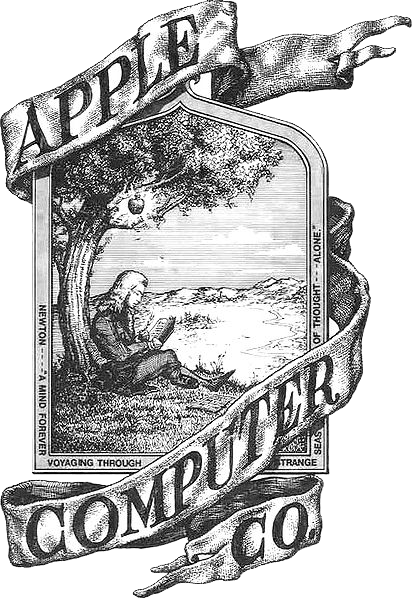 |
| Apple's first logo, 1st April 1976, Ron Wayne [3] |
This logo was quickly replaced by the logo almost as we know it now- designed by Rob Janoff, it was a streamlined apple with a bite out of it and coloured with rainbow stripes to symbolise the fact the Apple II could generate colour graphics. According to Steve Jobs, the company was named while he was on his way home from an apple farm while following a 'fruitarian' diet and thought it was "fun, spirited and not intimidating"[4]. That was also why the first official logo was multicoloured- again, it would make you think the company was warm and inviting because of the colours and this helped give the brand a 'friendly' personality, encouraging targets to use their product.
 |
| Apple logo,May 17 1976, Rob Janoff [5] |
From there the logo developed into the sleek and sophisticated monochrome apple we know today. The change in direction for the logo also encouraged a new marketing perspective, by trying to show users that Macs are professional and creative with their tv advertisements and using specific campaigns for their different products- i.e. Mac and iPod.
1. http://en.wikipedia.org/wiki/Brand , 08/10/2014
2. http://www.forbes.com/powerful-brands/, 21/10/2014
3. http://en.wikipedia.org/wiki/File:Apple_first_logo.png , 21/10/2014
4. CBC News. October 20, 2011, accessed 21/10/2014
5.http://en.wikipedia.org/wiki/File:Apple_Computer_Logo_rainbow.svg
Wednesday, 1 October 2014
Level 5- Target Markets and Consumer Needs
During this semester we have the task of hosting a Halloween party for us and our fellow students.
To target your consumer properly three things must be known.
To make this a successful event, market research is needed to be able to know the consumer needs of our target audience.
Target Market:
To target your consumer properly three things must be known.
- Who? This is one of the most important factors. Your target market may, for example, be children (children's books) but the consumer is the parents. If they don't like the look of something their precious child will be exposed too, they won't buy it full stop.
- Why? Another important part of the target is why they would buy a product. If their aim is to study, would they buy a games console or a laptop? If they want to have fun, would they rather purchase an algebra book or some tabletop puzzles?
- When? Birthdays, holidays and seasons are all vital in the marketing and targeting of a product. Thick, winter hoodies probably wouldn't be in as much demand in the height of summer as they would be come October, and how many people would buy a bikini at Christmas? Getting the timing right is just as important as targets and reasonings.
and whether or not they have the means to spend on parties and nights out or not.
Most students here are between the ages of 18-26 (with some obvious exceptions), and
with the new halls of residence opening around the corner from the uni it means more students can go out and stay out as opposed to last year.
The rent around this area is fairly cheap compared to the rest of the country (£50-£100p/w sometimes including bills i.e. gas and electricity), and being further up north means that the general cost of living is lower too, with shops being cheaper. Being in the town center means there is less to spend on travel too, opening up a larger budget for 'entertainment' and socializing.
The chosen venue for the party is the Art Café which is on campus. The other option was the theatrical town hall although the cost of this was too high, which would have meant the ticket price would have been higher thus driving our profits down. The only downside to using the Art Café is that some people might think it's a little amateur, although this can be avoided by decorating it and advertising it well.
One of the most important consumer needs for this party is that it need to be cheap, aesthetically pleasing and a lot of fun.
Food probably won't be needed as when drinking most people get a takeaway pizza when the night ends, or eat beforehand. There would need to be music either in the form of a DJ or live bands. Personally I think a DJ would be better because most people know chart and pop songs and if you know music you're more likely to enjoy and dance to it. A DJ is also much likelier to be cheaper than live bands as more than one would be needed to fill the whole night. There is a lot of diversity in the college too which means one band definitely won't fit all.
Target Market:
- Students age 18-26
- Both males and females
- Diverse music tastes
Consumer Needs:
- Cheap entry
- Cheap drinks
- Close location to campus
- A range of music
- Good decorations, spooky atmosphere
[1] http://en.wikipedia.org/wiki/Target_market , 01/10/14
Wednesday, 2 April 2014
Report Research- Survey
The first bit of research I collected was a survey, aimed at people in and around the North East (this was because I would be advertising the survey on my Facebook page and through email, and so it would be reaching people I know who live in the North East area).
There were eight questions in my survey, and I purposefully kept it short and sweet so as to prevent the respondents from being disheartened or just plain bored. 36 people in total answered the survey, which was a lot more than expected, and four provided comments at the end about the books and their experience with them.


As seen in the results, some respondents selected more than one answer for a question, some skipped questions and some added comments to the survey. Although one comment wasn't helpful, the others were and allowed some good insight into general opinion on the books.
There were eight questions in my survey, and I purposefully kept it short and sweet so as to prevent the respondents from being disheartened or just plain bored. 36 people in total answered the survey, which was a lot more than expected, and four provided comments at the end about the books and their experience with them.
As seen in the results, some respondents selected more than one answer for a question, some skipped questions and some added comments to the survey. Although one comment wasn't helpful, the others were and allowed some good insight into general opinion on the books.
Report Statement
The topic I have chosen for my report is children's book publishing. In this field I have chosen to research one particular publishing house, Penguin books. I chose it because it's a huge company that has published books for years and is one of those iconic brands book-lovers will always instantly recognise.
Within the Penguin publishing house there are two off-branches- these are the specifically targeted Puffin and Ladybird books, aimed at children and teens.
After collecting research on these branches, I will be comparing the fictional publications and the non-fiction books, and using my resources to find which is more popular.
Within the Penguin publishing house there are two off-branches- these are the specifically targeted Puffin and Ladybird books, aimed at children and teens.
After collecting research on these branches, I will be comparing the fictional publications and the non-fiction books, and using my resources to find which is more popular.
Tuesday, 1 April 2014
Agencies
The right agent or agency can provide plenty of work and job opportunities for any artist, and thus they are an important part of the industry. They are especially skilled at networking and this is what makes them so valuable.
So how do you choose the right agent for you and your style?
So how do you choose the right agent for you and your style?
- Some agents may have a 'house' style
- Some may focus only on UK opportunities
- Some may be able to look over the EU too
- Others may even have worldwide connections
- They may only target a specific market
- Some agents may push you to be 'flexible' to meet income opportunities
- A good agent should try to push you as a 'brand'
- How do I want to be represented?
- How do I want to be perceived by the industry?
- How will I want to win commissions?
Thursday, 13 February 2014
CV's for Creative Pracitioners (unfinished)
Most people have a CV (Curriculim Vitae). This is to help a
prospective employer get an idea of your skills, qualifications and
personal qualities, however when working within the creative industry we
can bend the rules a little bit and add into these documents our own
stylistic flair. CV's for creative practitioners can be a much better
way of presenting yourself to potential agents or other clients, as you
can tailor the format of the CV to yourself and let some of your
artistic and commercial style show through. You also don't need to put
ALL of your qualifications into it- only relevant information should be
supplied such as art or design related qualifications and any other
information they may be interested in like work experience and previous
jobs (if any).
However, considering this, these creative CV's should be sharp and proffesional whether they are eye catching or not. They should promote your style well and although presentation is important this doesn't necessarily mean it has to be really unusual either.
In order to make my own 'creative' CV I am first researching some existing examples and anaylsing them so I know what works and what really doesn't in regards to this.

I did not think this was a great creative CV. If I was an employer and was handed this, well, first of all I would be confused as to where to start. There is way too much information and text crammed into too small a space. The idea was good but the execution could have been a lot better.

I liked this CV because the information is laid out in a concise, clear way in a good type and the colour scheme isn't too loud. I'm not too keen on the crumpled paper effect but the little arrows and icons add a nice touch and I especially like the main heading of the page. It's very graphically designed but I think it works well and I would enjoy reading a CV like this.

In theory this a good design for a CV.
I like the general layout of the CV, especially the black dividing box and the photo he has provided of himself. The information, although not laid out in a traditional CV style, is well presented in a good typeface and I like the font he has used for headings.
The only qualm I have with this CV is the background colour; the bright yellow is a little too bright for my taste (you want to impress employers, not blind them!)
However, considering this, these creative CV's should be sharp and proffesional whether they are eye catching or not. They should promote your style well and although presentation is important this doesn't necessarily mean it has to be really unusual either.
In order to make my own 'creative' CV I am first researching some existing examples and anaylsing them so I know what works and what really doesn't in regards to this.
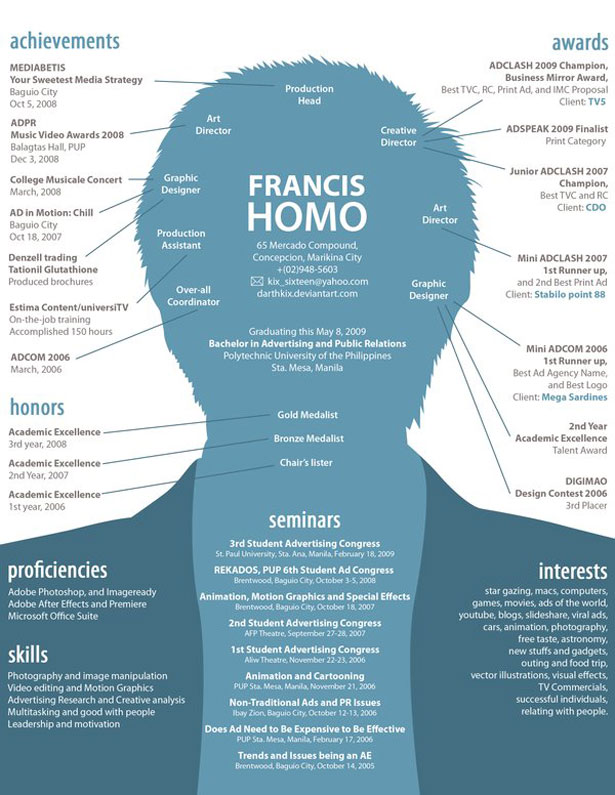
I did not think this was a great creative CV. If I was an employer and was handed this, well, first of all I would be confused as to where to start. There is way too much information and text crammed into too small a space. The idea was good but the execution could have been a lot better.
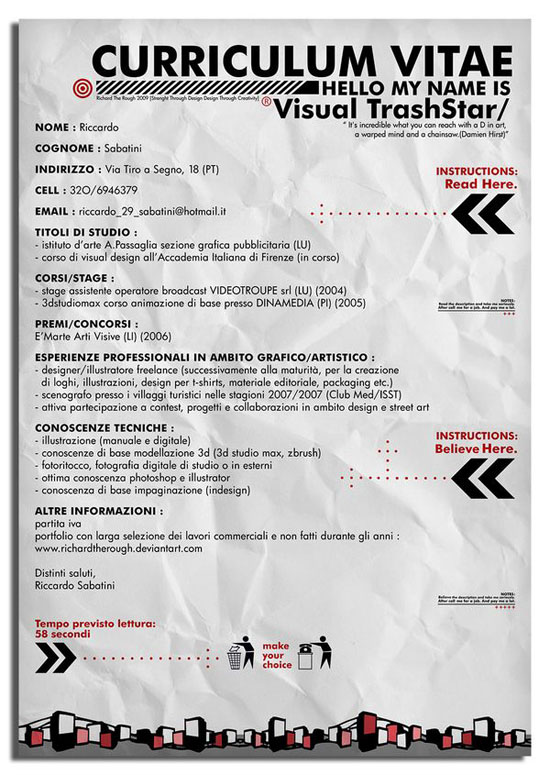
I liked this CV because the information is laid out in a concise, clear way in a good type and the colour scheme isn't too loud. I'm not too keen on the crumpled paper effect but the little arrows and icons add a nice touch and I especially like the main heading of the page. It's very graphically designed but I think it works well and I would enjoy reading a CV like this.
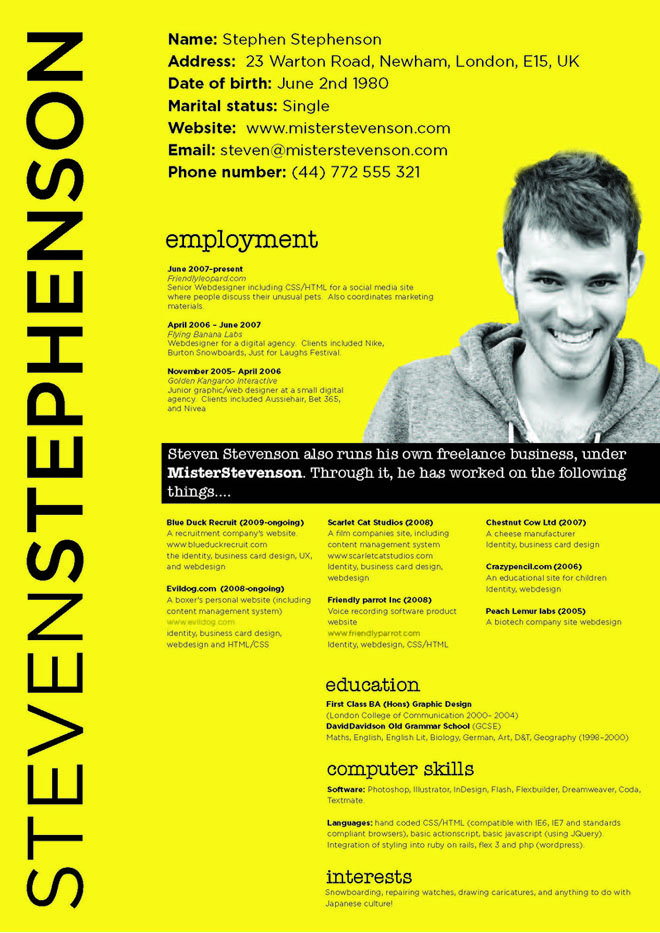
In theory this a good design for a CV.
I like the general layout of the CV, especially the black dividing box and the photo he has provided of himself. The information, although not laid out in a traditional CV style, is well presented in a good typeface and I like the font he has used for headings.
The only qualm I have with this CV is the background colour; the bright yellow is a little too bright for my taste (you want to impress employers, not blind them!)
Post Graduate Courses (unfinished)
After I complete this degree course, if I want to I can choose to
enroll in a post graduate course. I've thought about this option a lot
as I would like to further my education, I'm just not sure which course I
would enjoy the most and I like the idea of a few different options,
from Fine Art degrees or curatorial ones.
The entry requirements needed are a relevant Level 6 qualification, which means that if I successfully complete my degree I can progress onto this course. However other entrants without this degree can also enroll on the course if they have suitable professional experience that could possibly be substituted for traditional academic qualifications.
For 2013/14 the course fees are as follows:
£5,540 Full Time UK/EU
£2,995 Full Time UK/EU
Courses in England
Falmouth University
MA Illustration: Authorial Practice
This MA in illustration has a specific focus on narrative (authorial) illustration. The name of the course intrigued me and I was impressed with the quality of work displayed on the professionally presented website.The entry requirements needed are a relevant Level 6 qualification, which means that if I successfully complete my degree I can progress onto this course. However other entrants without this degree can also enroll on the course if they have suitable professional experience that could possibly be substituted for traditional academic qualifications.
For 2013/14 the course fees are as follows:
£5,540 Full Time UK/EU
£2,995 Full Time UK/EU
Intellectual Property Protection
Copyright, as defined on the UK Intellectual Property Office website, can protect:
"
"
You should only copy or use a work protected by copyright with the copyright owner's permission.
- literary works, including novels, instruction manuals, computer programs, song lyrics, newspaper articles and some types of database
- dramatic works, including dance or mime
- musical works
- artistic works, including paintings, engravings, photographs, sculptures, collages, architecture, technical drawings, diagrams, maps and logos
- layouts or typographical arrangements used to publish a work, for a book for instance
- recordings of a work, including sound and film
- broadcasts of a work
Copyright applies to any medium. This means that you must not reproduce copyright protected work in another medium without permission. This includes, publishing photographs on the internet, making a sound recording of a book, a painting of a photograph and so on.
Copyright does not protect ideas for a work. It is only when the work itself is fixed, for example in writing, that copyright automatically protects it. This means that you do not have to apply for copyright.
A copyright protected work can have more than one copyright, or another intellectual property (IP) right, connected to it. For example, an album of music can have separate copyrights for individual songs, sound recordings, artwork, and so on. Whilst copyright can protect the artwork of your logo, you could also register the logo as a trade mark. "
Visual Plagiarism
What is Visual Plagiarism?
Visual Plagiarism is where you take somebody else's ideas and work and pass them off as your own. It is considered both cheating and theft- if a student plagiarises, it is viewed as an attempt to gain an advantage over other students in assessments and gradings as they are trying to use other people's ideas and works.In the working world it is an even more serious offense and is treated as theft- the plagiarist is stealing another person's work to use it as their own and this can result in a hefty fine, a lengthy lawsuit and a ruined reputation.
What about homage?
It's not all so black and white in the art and design world. People can pay 'homage' to, or be greatly inspired by, the works of others from previous times.A classic example of this is the painting 'Night Hawks' by Edward Hopper (1942).

It is his most famous painting and also one of the most copied... but not plagiarised. How?


These two images are so obviously directly influenced by 'Night Hawks', it would be easy to say that the artists plagiarised the work. However, being inspired by another person's work and creating a piece that pays direct reverance to that work is often referred to as 'homage' and there is a long standing history of this in art and design.
Homage would be plagiarism if the artist tried to say that the work was all their own creation... But this would be an incredibly stupid move and it's obvious with a painting so famous as 'Night Hawks' that any copies would be a homage to it.
The problem today (especially with the help of the internet) is that the plagiarism of lesser-known works is becoming much more common. Artists and designers today are now combatting this and there has been a rise in court cases against infringing individuals in the USA especially.
Examples of Plagiarism

This image is the original artwork of Samantha Ravndahl, who is the artist, model and photographer of this piece.

This is Lil' Kim's cover for her Nov 2013 single 'Dead Gal Walking', clearly directly taken from Samantha's photograph. Lil' Kim and her team are now facing legal action from Samantha as a result of this, and are being sued for a massive $150,000.
(sourced from http://youthoughtwewouldntnotice.com/ and http://www.musictimes.com/)

In this image the work on the left is plagiarised from the photography work on the right.
Copying a photograph in another media is still plagiarism- although you could say 'I used the photo as a reference' that would be untrue as the details, composition and content of the images are almost exactly the same as the photos.
Another thing to note is that reference photographs should always be credited (even if they are free use you should always check the terms- some sites may require a license or other registration before you can use them!) and some stock providers will not allow their stock to be used commercially.
(sourced from http://youthoughtwewouldntnotice.com)
Why are Macs the industry standard in art and design today?
Macs are the industry standard in art and design today for one specific reason.
iMacs have been used by creatives since 1984, because they had the edge over PCs in one crucial aspect: Mac screens can be calibrated accurately to ensure no colour values are lost between the machine and the printers, while when working on a PC there is potential for the colours to change at the printers which would put to waste hours worth of work.
Since the beginning the aesthetic design of the Mac was also primarily aimed at designers- unlike the PC's rigid, industrial tower design (PC's were aimed at businessmen) the Macs had a fun, innovative design and pioneered the all-in-one desktop computer.
Personally, I prefer PCs. I think Macs can be very overpriced for their components; for example, I myself own a £700 gaming laptop with almost twice the spec of a £1,200 Mac. PCs are also upgradeable, unlike Macs, as their warranty is voided if the back cover is removed or tampered with. I feel like you are paying for both the name and the design when buying a Mac, while with a PC you are paying for the actual worth of the machine. PCs are also more compatible with gaming software, although design software works equally well on both.
Unfortunately, although I prefer PCs, I do acknowledge and accept the fact I'll probably have to buy a Mac at some point in my career as it simply is the industry standard and that isn't likely to change.
iMacs have been used by creatives since 1984, because they had the edge over PCs in one crucial aspect: Mac screens can be calibrated accurately to ensure no colour values are lost between the machine and the printers, while when working on a PC there is potential for the colours to change at the printers which would put to waste hours worth of work.
Since the beginning the aesthetic design of the Mac was also primarily aimed at designers- unlike the PC's rigid, industrial tower design (PC's were aimed at businessmen) the Macs had a fun, innovative design and pioneered the all-in-one desktop computer.
 |
| An indigo iMac
G3 (circa 1998). These iMacs were available in a number of different
specs and colours. Credit to www.wikipedia.org
Macs are also generally viewed as being more stable and reliable, unlike PCs which are more susceptible to hardware issues and viruses.
|
Unfortunately, although I prefer PCs, I do acknowledge and accept the fact I'll probably have to buy a Mac at some point in my career as it simply is the industry standard and that isn't likely to change.
Début Art Agency and The Coningsby Gallery
Début Art
début art is based primarily in London and also has offices in Paris, New York and Berlin.
It
was formed in 1985 and actively seeks out leading contemporary image
makers and clients, ensuring the creation of original, progressive and
successful media material.
This
agency and the illustrators and animators it markets have taken on
awesome assignments worldwide, including companies that are leaders in
their fields, including Microsoft, Apple, Coca-Cola, Harper Collins,
Penguin Books, Universal Music and Sony. Doing commissioned work for
these massive companies would give massive exposure and promotion of
work, and this is something I would be interested in as an aspiring
illustrator.
Another reason I
wanted to research this particular agency was because of the great style
diversity within the illustrators it markets:

This is a screenshot showing the contrasting styles between each illustrator and graphic designer.
I
like that there is a clear difference between each individual and it's
good that each of them are unique because it gives the agency a
potentially huge diversity in their client base. This also means there
is no 'house style' that some agencies promote, which really does mean
that there can be something for every client.
The
agency represents 142 illustrators (as of publishing) and was founded
by Andrew Coningsby, who is available to email directly at
andrew@debutart.com.
There is also directions and a map to pinpoint the location of the building and they've even written which buses can take you there, which can be helpful for both clients and artists alike.

Andrew Coningsby also runs and directs a gallery space at the same location, the Coningsby Gallery. The gallery exhibits a range of art, from illustrative pieces and fine art works to graphic and type design. The information on the gallery's website is very useful for prospective exhibitors, as there is a calendar showing free spaces for exhibitions and a PDF file outlining the full details of the space such as measurements and hanging requirements.


Some exhibitions held there are presented by a range of artists- not only illustrators and graphic designers exhibit there but also photographers, fine artists and even sculpture and craft works.


There is also directions and a map to pinpoint the location of the building and they've even written which buses can take you there, which can be helpful for both clients and artists alike.
Andrew Coningsby also runs and directs a gallery space at the same location, the Coningsby Gallery. The gallery exhibits a range of art, from illustrative pieces and fine art works to graphic and type design. The information on the gallery's website is very useful for prospective exhibitors, as there is a calendar showing free spaces for exhibitions and a PDF file outlining the full details of the space such as measurements and hanging requirements.
Some exhibitions held there are presented by a range of artists- not only illustrators and graphic designers exhibit there but also photographers, fine artists and even sculpture and craft works.
Children's Book Publishing (Scholastic)
Children's book publishing is one of the fastest growing parts of
publishing. It's a lively part of consumer publishing and is split into
different age categories, like baby books, books for toddlers and
preteens and even young adults.
The first publishing house I have researched is Scholastic, mainly because when I was a kid (and even now) I read a multitude of their books, from the Heartland series by Lauren Brooke and all of author Maggie Steifvater's books (the Shiver trilogy, the Scorpio Races, the Raven Boys and the Lament series). Scholastic targets all ages of children, and also publishes educational books for schools. Scholastic tries to encourage literacy by hosting book clubs and fairs and trying to spread the message that 'reading is rewarding'.
A book fair is where a portable 'library' is taken to schools and actual libraries so that kids can go and choose books to buy. This is really great way of making literature more accessible to children, as it's not always possible for them to go down to their local WHS's or Waterstones to browse.
To contact Scholastic, there are a number of possibly useful details on their 'Contact Us' webpage (http://www.scholastic.co.uk/contactus). From this I have decided to contact the company via email, through their children's book email adress.
[1] Scholastic, 'What is a Scholastic Book Fair?' http://bookfairs.scholastic.co.uk/what_is?nt=t
(31/3/2014)
The first publishing house I have researched is Scholastic, mainly because when I was a kid (and even now) I read a multitude of their books, from the Heartland series by Lauren Brooke and all of author Maggie Steifvater's books (the Shiver trilogy, the Scorpio Races, the Raven Boys and the Lament series). Scholastic targets all ages of children, and also publishes educational books for schools. Scholastic tries to encourage literacy by hosting book clubs and fairs and trying to spread the message that 'reading is rewarding'.
 |
| Screenshot from the Scholastic site |
A book fair is where a portable 'library' is taken to schools and actual libraries so that kids can go and choose books to buy. This is really great way of making literature more accessible to children, as it's not always possible for them to go down to their local WHS's or Waterstones to browse.
Book fairs are also themed to help garner interest, and schools are given compeitions and activities based on each theme to get children more involved.What is a Scholastic Book Fair?
A Scholastic Book Fair is a wonderful reading event held in your school for everyone to enjoy. We supply you with mobile bookcases packed with the very best books to sell to your pupils to help them develop a life-long love of reading. [1]
To contact Scholastic, there are a number of possibly useful details on their 'Contact Us' webpage (http://www.scholastic.co.uk/contactus). From this I have decided to contact the company via email, through their children's book email adress.
Dear Sir/ Madam,Hopefully a member of staff will answer these questions as they will be useful to know about, especially questions 1, 2, and 3.
I am currently an undergraduate student studying Illustration at Cleveland College of Art and Design. For one of my studio modules we are required to research publishing companies and I wondered if you could answer some questions (typed below) needed for this?
Many thanks,
Sophie Babur
1. Has children's book publishing increased in popularity over the past four years?
2. If so, why do you think this is?
3. How important is illustration in children's books and why?
4. Have book fairs become more popular in recent years or not?
5. How important are book fairs to encourage children to read and how successful are they in general?
[1] Scholastic, 'What is a Scholastic Book Fair?' http://bookfairs.scholastic.co.uk/what_is?nt=t
(31/3/2014)
Wednesday, 12 February 2014
Types of Publishing
Throughout the industry there are different types of publishing, and each illustrator can find specific cubbies which their work will suit perfectly. The market for literature throughout the world is huge and has many sub-markets with specific targets and audiences. Understanding these different types of publishing is important and can help me identify the ideal aspect of this for me to explore.
Looking at the rundowns of each type of publishing, at this moment in time I would place myself in the children's book category, with interests in educational and academic texts. Therefore I will be researching popular publishers within these markets, in order to gain insight into the industry.
General/ Consumer Publishing
- Mass market paperbacks
- Accounts for 60% of sales in the UK
- Includes widely known, popular titles, both fiction and non fiction
- Does not include children's books
- Can be anything narrative
Children's Book Publishing
- Rapidly gaining in popularity in recent years
- A lively, exciting aspect of consumer publishing
- Has more sub-markets within the genre- ie age ranges
Journals
- Include educational, academic, scientific, technical and medical publications
- 3D illustrations are popular (especially in medical proffesions)
- Holds lots of opportunities for graduates specialising in this area
Newspapers/ Editorial
- Includes magazines, newspapers, editorials, periodicals
- Can be in house as well as commissioned
- Has a high turnover of images
- Runs to tight deadlines
- Takes on many new graduates
Looking at the rundowns of each type of publishing, at this moment in time I would place myself in the children's book category, with interests in educational and academic texts. Therefore I will be researching popular publishers within these markets, in order to gain insight into the industry.
Introduction to Industry Structures
Design Houses
Design houses employ artists to create and supply images in a 'house style', meaning drawing and producing in a certain way to fit the specific style of the brand.- Artists hold no rights on sold images- flat payment only
- Gives a steady source of income
- This can be a good place to start for some, i.e. as a 'desk job' while gaining freelance and other creative work
Freelancing
Freelancing is a way of working that means it is all up to you. You decide where and when you work, for how long and in what ways. Freelance artists can either get commissioned work through networking themselves or working with an agent who secures breifs from clients, possibly on an international scale. It can be very hard to be freelance only and most illustrators and artists supplement their freelance income with other jobs, wether creative or not.- Majority of artists are freelance
- Use a recognised legal structure (important)
- Can sell work for a smaller initial sum but gain income from copies sold
- Usually start working from home
Networking
Networking is an important aspect of any industry, and especially in the creative sector. Building a chain of industry links leads to commissions and income, and partnerships with agencies and publishing houses can ensure a steady wage.- Who can help me?
- Who can support me?
- Can lead to introductions to new markets and commissions
Collaborations
A lot of artists collaborate with each others to combine their works in new and unusual ways. Some artists work exclusively together in partnerships, with one member taking on one role and the other something else.- Collaborations are important
- They combine skills
- Who can help me and add to my work?
- Networking can lead to collaborations
Galleries
Galleries and exhibitions are a crucial part of the creative industry. Again, they can be a source of income if marketed and presented properly, and can open up new links with possible clients.- Galleries exhibit and sell original work, digital prints and limited edition prints
- Researching relevant galleries will be important in my work
- Galleries can expose new illustrators and provide an entry into the industry
Competitions
Competitions are frequently held in the illustration world, both nationally and internationally. If chosen correctly they can offer huge (even worldwide) exposure and are another window for potential clients and agencies to view your work.- Industry personel will be there
- Mediocre and bad work will be remembered
- Are held in a number of different disciplines including illustration only
Subscribe to:
Posts (Atom)